

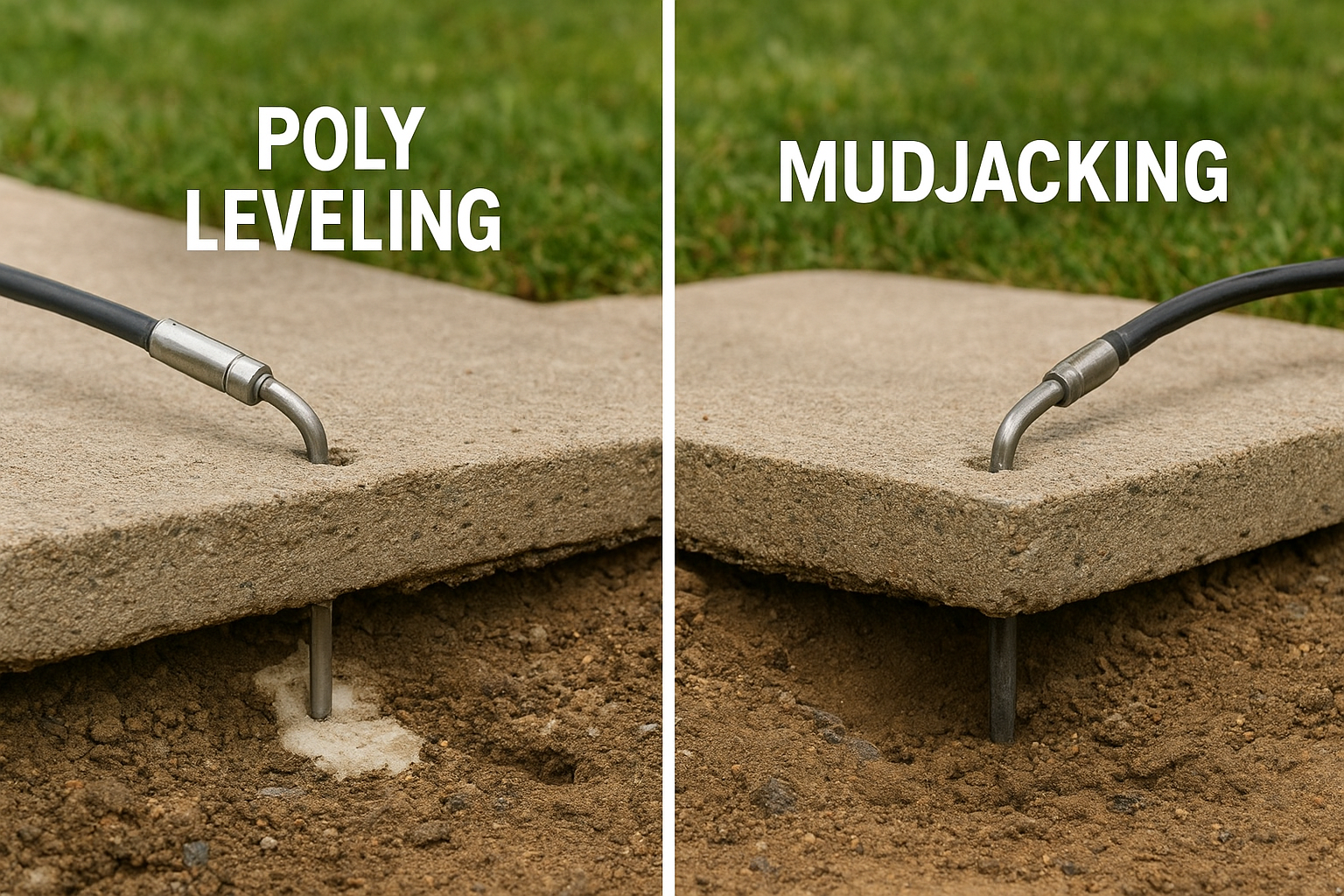
Over time, concrete slabs—whether it’s your driveway, sidewalk, or patio—can begin to sink or settle unevenly. This can happen due to soil erosion, water infiltration, or poor initial compaction. When this happens, you’re left with unsightly, uneven surfaces that can create safety hazards and reduce your property’s curb appeal.
Fortunately, two popular repair methods can fix sunken concrete: mudjacking and poly leveling (polyurethane foam injection). Both are designed to lift and stabilize concrete, but they differ significantly in materials, process, cost, and long-term results.
In this article, we’ll break down Poly Leveling vs. Mudjacking to help you decide which is the better fix for your property.
What Is Mudjacking?
Mudjacking, also known as slabjacking, is a traditional concrete leveling method that’s been around for decades. It involves pumping a heavy mixture (made from water, soil, sand, and cement) beneath the sunken concrete to lift it back into place.
How Mudjacking Works:
- Small holes (about 1–2 inches in diameter) are drilled into the affected concrete slab.
- The slurry mixture is pumped into these holes under pressure.
- The hydraulic pressure lifts the slab until it reaches the desired level.
- Finally, the holes are patched with concrete.
Advantages of Mudjacking:
- Cost-effective: Generally cheaper than poly leveling.
- Quick process: Can be completed within a few hours.
- Proven method: Used for decades in residential and commercial repairs.
Disadvantages of Mudjacking:
- Heavier material: The slurry mixture can weigh 30–50 times more than polyurethane foam, which may cause further soil compression over time.
- Larger drill holes: The bigger holes can be more visible and take longer to blend in.
- Less durability: The mixture can wash out or erode again with water infiltration.
- Not ideal for all surfaces: Heavier materials may not work well for thin slabs or areas with unstable soil.
What Is Poly Leveling (Polyurethane Foam Injection)?
Poly Leveling is a modern, advanced concrete lifting technique that uses lightweight, expanding polyurethane foam. It’s often referred to as polyjacking and is known for its precision, speed, and durability.
How Poly Leveling Works:
- Technicians drill small holes (about ⅝ inch in diameter) into the concrete surface.
- A two-part polyurethane foam is injected beneath the slab.
- The foam expands, filling voids and lifting the slab to the correct level.
- Once the foam hardens, the holes are sealed, and the area is ready for use within minutes.
Advantages of Poly Leveling:
- Lightweight and long-lasting: The foam won’t add extra weight to the soil and is resistant to water, erosion, and decay.
- Smaller holes: Less noticeable and more aesthetically pleasing.
- Quick curing time: Surfaces are usable in as little as 30 minutes.
- Highly precise: Allows for better control during lifting.
- Water-resistant: The closed-cell foam prevents water infiltration, reducing future settling.
- Eco-friendly options: Some foams are made with recycled materials.
Disadvantages of Poly Leveling:
- Higher initial cost: Typically more expensive than mudjacking.
- Requires professional expertise: Needs trained technicians and specialized equipment.
- Not DIY-friendly: Unlike minor mudjacking repairs, poly leveling must be done professionally.
Key Differences Between Poly Leveling and Mudjacking
| Feature | Mudjacking | Poly Leveling |
|---|---|---|
| Material Used | Slurry mix (cement, soil, sand, water) | Expanding polyurethane foam |
| Hole Size | 1–2 inches | ⅝ inch |
| Weight on Soil | Heavy | Lightweight |
| Cure Time | 24–48 hours | 15–30 minutes |
| Durability | Prone to erosion | Highly durable |
| Precision | Moderate | High |
| Cost Range | $4–$8 per sq. ft. | $5–$12 per sq. ft. |
| Water Resistance | Poor | Excellent |
| Aesthetic Finish | Larger patch marks | Nearly invisible patches |
When to Choose Mudjacking
Mudjacking is a solid choice if you’re looking for a budget-friendly, short-term fix for concrete settlement issues. It works best for:
- Garage floors
- Patios and walkways
- Interior slabs with minimal traffic
- Projects where aesthetics are less critical
However, if the area is prone to water issues or unstable soil, the heavy mud mixture can make the problem worse in the long run.
When to Choose Poly Leveling
Poly Leveling is ideal for homeowners or businesses who want a permanent, clean, and fast solution. It’s best suited for:
- Driveways and sidewalks
- Pool decks
- Commercial floors
- High-traffic or water-prone areas
If you’re planning to sell your home, poly leveling can enhance curb appeal and property value thanks to its seamless finish and long-lasting results.
Which Is the Better Fix?
When comparing Poly Leveling vs. Mudjacking, the “better” option depends on your priorities:
- For longevity and minimal maintenance: Choose Poly Leveling.
- For cost savings and smaller projects: Mudjacking can still be effective.
- For precision lifting and water resistance: Poly Leveling is the clear winner.
While mudjacking can still serve as a temporary fix, it’s gradually being replaced by polyurethane foam injection due to its superior performance and durability.
The Long-Term Value of Choosing the Right Method
Investing in the right concrete lifting method can save you thousands in future repairs.
Uneven concrete isn’t just an eyesore—it’s a liability. Trips and falls, vehicle damage, and water pooling can all result from ignored settlement issues.
Poly Leveling, while more expensive upfront, offers:
- A longer-lasting solution
- Faster repair time
- Reduced future maintenance costs
In contrast, mudjacking may require repeated treatments over the years, adding up to higher cumulative expenses.
Final Thoughts
Both Poly Leveling and Mudjacking can effectively lift and stabilize sunken concrete. However, when considering the balance between cost, durability, and aesthetics, Poly Leveling emerges as the superior, long-term solution.
If you want your driveway, patio, or sidewalk to look great and stay level for years, polyurethane foam injection offers the strength, precision, and reliability that traditional mudjacking can’t match.
Before you decide, always consult with a professional concrete leveling contractor. They can assess your site conditions and recommend the best method for lasting results.
